
Sales · Long distance
Long-distance moves, priced by your tariff.
MoveBoard measures the move, decides whether it's local, intrastate or interstate, and prices it by your tariff: mileage, 400N-style, single factor, cubic foot, flat rate or regions. The delivery spread, the federal bill of lading with scale weights, storage in transit and the trips all hang off the same order.
- kinds of long-distance tariff
- 6kinds of long-distance tariff
- of a non-binding estimate, at most, at delivery
- 110%of a non-binding estimate, at most, at delivery
- day billable SIT period, or your own
- 180day billable SIT period, or your own
Order LD-2238 · Booked · Interstate
Lina Park, Boston → Savannah
MovePickupDelivery
Quote
Tariff Standard Mileage · Billed weight 7,000 lbs
Delivery Oct 19 – Oct 22 · est. Oct 20
Binding: the customer pays $3,963.50 plus only services added later.
What it fixes
The day before Long distance, and the day after.
Long moves are quoted from a spreadsheet, a mileage chart and a calculator.
The tariff prices the line haul on the order, and one press shows every step.
The truck weighs heavier and the driver doesn't know what to collect at the door.
The bill re-rates on the net scale weight and shows what to collect now and what's billed later.
A shipment sits in the warehouse and nobody sends the SIT notice in time.
The SIT board counts the days and emails the conversion notice on its day.
How it works
Long distance, screen by screen.
01 / Your tariffs
Six kinds of tariff, one default per move type.
Build a Mileage grid, a 400N-style tariff, a Single Factor Rate, a Cubic Foot tariff, Flat Rate LD or a Regions tariff between states, regions or area codes. Each move type (residential, commercial, military) uses one method by default, and any order can be priced by another of your tariffs instead.
- Price per 100 lbs, per pound or per cubic foot
- A weight factor turns cubic feet into pounds, kept on each order
- Minimum weights and minimum prices
- A new company starts with a ready Standard Mileage tariff
Settings · Long distance
How long distance is priced
Mileage
Distance × size grid
400N-style
Per 100 lbs by band and weight
Single Factor Rate
One rate per 100 lbs
Cubic Foot
Rate per cubic foot
Flat Rate LD
By move size and distance
Regions Tariff
Between states, regions, area codes
Every move type
Residential: MileageCommercial: Cubic FootMilitary: 400N-style
02 / The linehaul
Every step of the price, on the order.
Press the Linehaul Charge on the quote and MoveBoard shows how it got there: the tariff, the distance band, the weight, the rate, the accessorials, then fuel, valuation and the estimate type. Under the totals, one line says what the estimate promises the customer, binding, non-binding or not to exceed.
- Extra pickups and drop-offs, stairs, elevators, long carry and shuttles
- Type over a rate for one order; the arrow puts the tariff's back
- Local, intrastate or interstate picked from the addresses
- Kilometres and provinces for Canadian branches
Order LD-2238
Long-distance charges, step by step
1 · Tariff
2 · Line haul
3 · Accessorials
4 · Fuel, valuation, estimate
03 / Dates
Spreads you promise, and can keep.
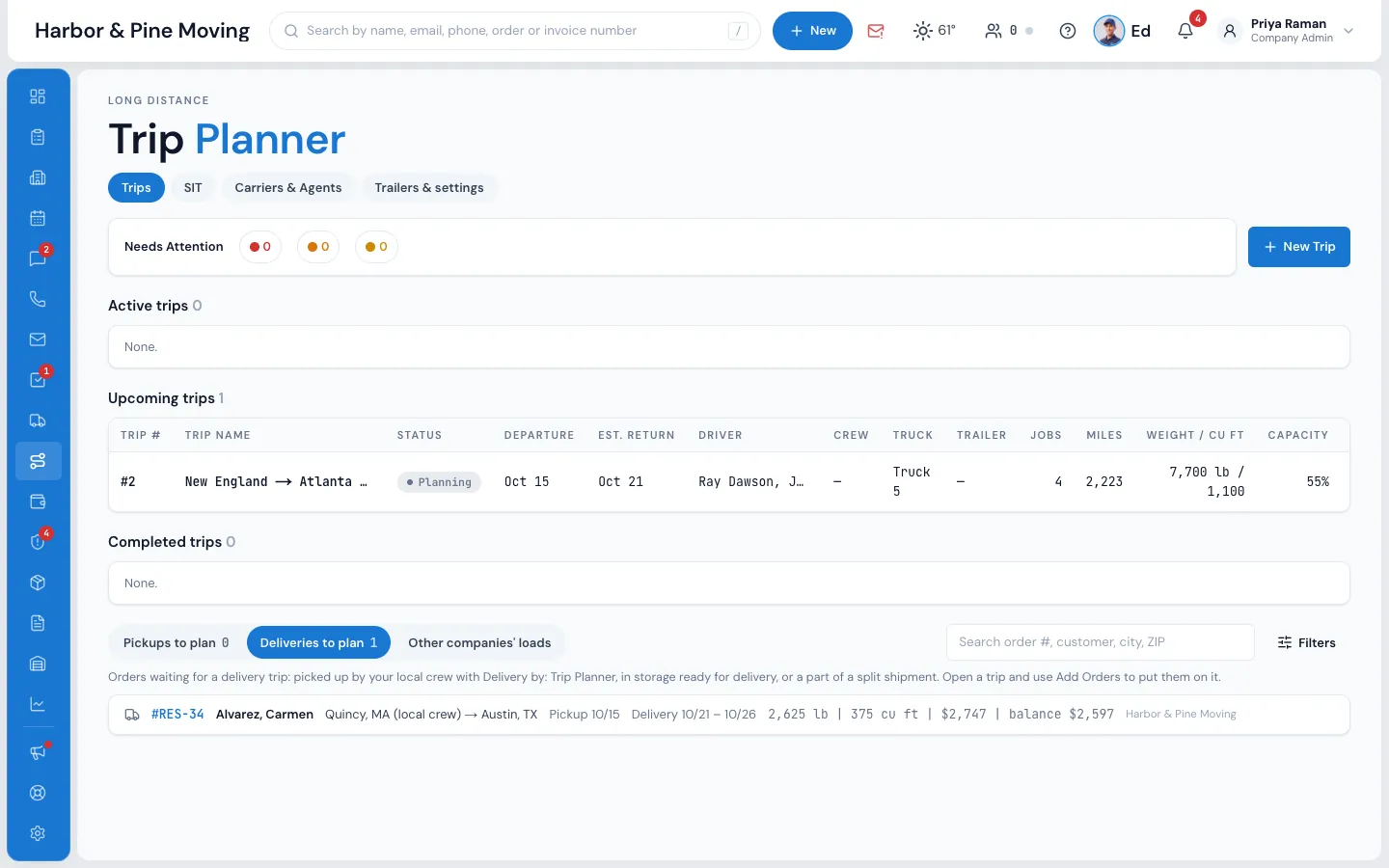
Each order carries a pickup spread and a delivery spread: the delivery days, the first available delivery date and your estimated delivery. The customer sees them on the estimate, the order for service, the bill of lading and their portal. Choose who does each half, your local crew or the Trip Planner.
- A suggested truck hold, split into days of at most 11 hours of driving
- A delay record when the delivery has to move
- The weight-and-charges notice, a business day ahead, when the customer asks
Order LD-2238 · Move details
The delivery, promised and kept
DeliveryPickupDelivery
On the Trip Planner
Trip #T-0412 · New England to Atlanta run Scheduled
Leaves Oct 16 · back Oct 23
Delivery stop Oct 20, inside the spread
The customer sees the pickup spread and the delivery spread on the estimate, the order for service, the bill of lading and their portal.
04 / The scale weight
Weighed, re-rated, collected right.
Choose your own long-distance bill or MoveBoard's federal one. The crew types the tare and gross from the weight ticket and photographs it; the net works itself out. At delivery the charges are re-rated on the net weight, and on a non-binding estimate the bill collects at most 110% of the estimate, with the rest billed later.
- Valuation declared and signed at pickup
- A re-weigh at delivery when the customer asks
- A federal checklist for your own template
Back
Order LD-2238 · Pickup
Long-distance bill of lading
Estimated weight
7,000 lbs
Net scale weight
7,280 lbs
Collect at delivery
$3,963.50
Weight ticket
Scale: Cat Scale #1142 · Worcester, MA
Photograph the weight ticket05 / Storage in transit
SIT on the clock, notices on time.
Trips › SIT lists every shipment waiting in a warehouse: carrier holds you don't bill, and billable SIT on its clock, 180 days unless you set your own. MoveBoard emails the conversion notice before SIT turns into permanent storage and gives the salesperson a task three days before. Bill the stay, schedule the delivery out, or deliver part now and the rest later.
- SIT priced from the tariff's SIT rates onto the bill
- An early-delivery notice for a carrier hold
- Convert to permanent storage with a monthly rate
Trips · SIT
Storage in transit, on the clock
06 / Trips and reports
Put the shipments on trips.
Orders delivered by the Trip Planner wait on its board until you put them on a trip, many customers on one truck along one route. Eleven Long Distance reports cover tariffs, linehaul and fuel, estimated against actual weight, trip profit, on-time deliveries against the spread, SIT aging, deadhead miles, driver settlements and IFTA.
- Split an order across trucks or trips
- Haul loads for other companies, settled on their folio
- Carriers and agents with their own statements
“Online booking, instant pricing for the customer. One of the best input for the long distance tariff. User friendly.”
By the numbers
10
Days' written notice before SIT becomes storage
Or 1 day when the SIT period is shorter than 10 days (49 CFR 375.609). MoveBoard emails it on its day and keeps the record.
What's the difference between a binding and non-binding estimate for an interstate move?
A binding estimate is a fixed price for the goods and services listed; it changes only for services added later. A non-binding estimate is a close guess, and the final price comes from the scale weight and your tariff. In MoveBoard each kind of move has a Default Estimate Type (Flat Rate, Binding or Non-Binding), changeable per order, and the quote says in one line what the estimate promises.
How does the 110% rule work in the software?
On MoveBoard's federal long-distance bill of lading, the charges are re-rated on the net scale weight. On a non-binding estimate, Collect at delivery is capped at 110% of the estimate, and the bill shows the rest as billed after delivery.
Can the platform handle Storage-in-Transit (SIT) for interstate moves?
Yes. Trips › SIT tracks carrier holds and billable SIT by warehouse, counts the days against your SIT period (180 days by default), sends the conversion notice by email on its day, bills the stay from the tariff's SIT rates, and converts the shipment to permanent storage when you choose.
Does the software support mileage tariffs and zone tariffs at the same time?
Yes. Keep as many tariffs as you like: Mileage, 400N-style, Single Factor Rate, Cubic Foot, Flat Rate LD and Regions (between states, regions or area codes, with seasons). Each move type has one default method, and any order can be priced by another of your tariffs.
How does the software handle the difference between interstate and intrastate moves?
Each move type has a local, intrastate and interstate range, each with its own settings page and default estimate type. MoveBoard picks the kind from the addresses, can make any move that leaves your state interstate however short, and asks before changing it when a ZIP code changes later.
What FMCSA-required fields appear on the Bill of Lading?
MoveBoard's federal long-distance bill is built for 49 CFR 375.505: the pickup and delivery details, services ordered and performed, the signed valuation choice, the scale weights with the weight ticket and re-weigh, the re-rate, what may be collected at delivery, and pickup and delivery signatures, with your terms printed on it. A federal checklist shows what your own template misses.
How are weight tickets captured and reconciled?
At pickup the crew picks Origin weigh or Back weigh, types the tare and gross in pounds, and the net works itself out. They add the scale, its location, the date, the vehicle and the weigh master, and photograph the ticket. At delivery the charges are re-rated on that net weight.
Can the platform run multi-pickup, multi-delivery, or consolidated shipments?
Yes. Extra pickups and drop-offs are long-distance extra fees on the order. With the Trip Planner, many customers' orders ride one trip, each with its own bill of lading, and an order can be split between trucks or across trips.
Works with
Long distance hands the work to the next screen.
See your company on MoveBoard.
A live demo built around your own kind of moves: your service area, your pricing, your crews.